Why Leadership Transitions Succeed or Stall.
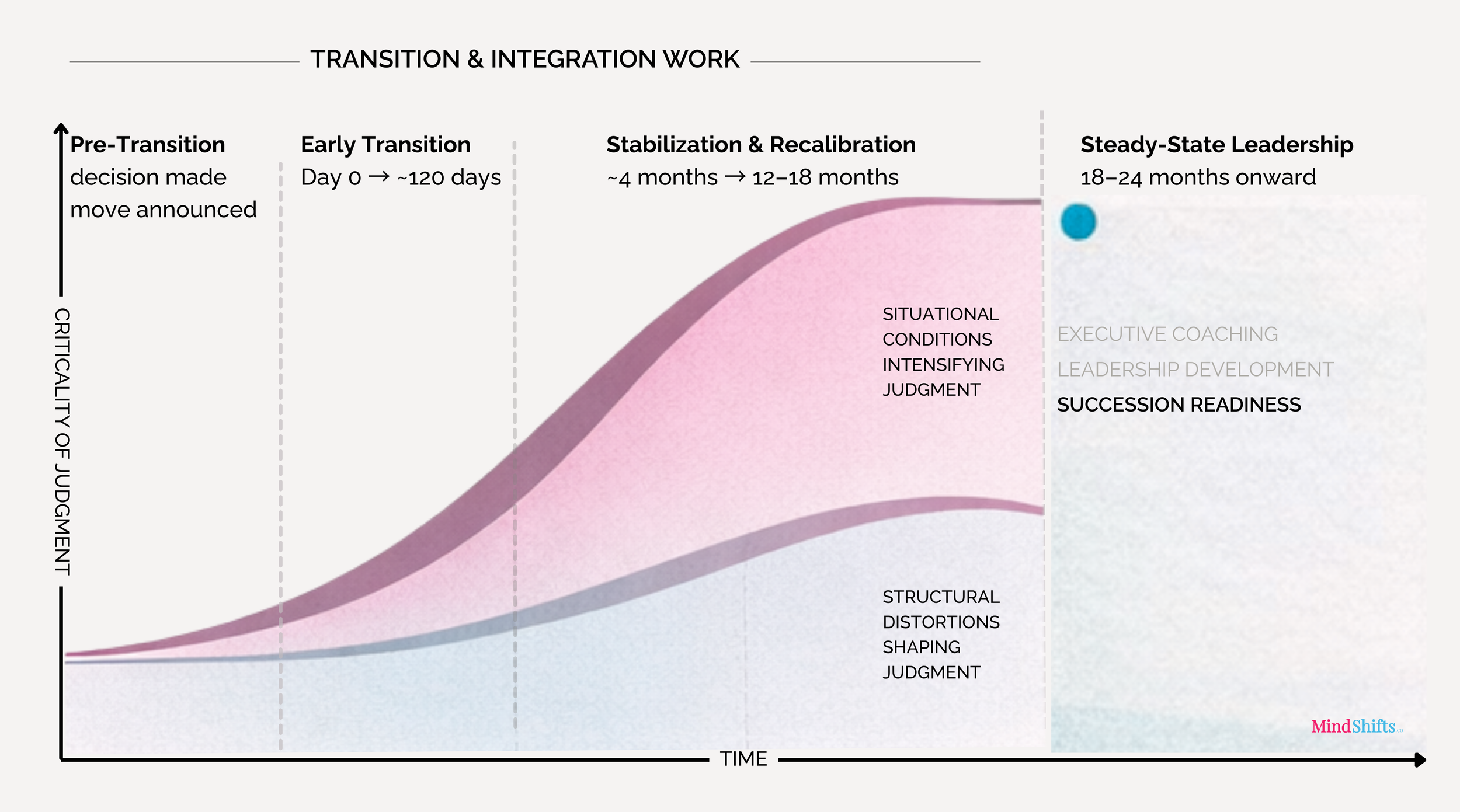
Leadership transition and integration work sits where judgment is most critical — before leadership patterns and early decisions quietly shape what follows
Judgment doesn’t become critical only after a leadership appointment. It’s already at work well before Day One.
It begins during succession identification and readiness, and continues through transition preparation and early integration — often quietly and unnoticed.
As soon as a decision is made, a move is announced, or succession conversations begin, leaders are required to operate in a new context.
Authority shifts.
Visibility changes.
Choices begin to signal more than intended.
What matters most during a transition isn’t whether judgment is present.
It’s how judgment changes as conditions around it change.
The early window most leadership support misses.
In the pre-transition and early transition phases, judgment is active — but unevenly supported.
Leaders are often still carrying internal reference points from their previous roles, even as the system begins responding to them differently. Feedback is indirect. Signals are subtle. What’s not working is harder to name.
By the time misalignment becomes visible, early patterns may already be forming.
Every transition context is different.
What a vertical move demands is different from what a lateral shift demands.
A leadership restructuring creates different pressures than a large-scale technology change.
But across contexts, certain forces repeat.
When structure bends judgment.
This is where structural distortions begin to shape judgment — not because of the individual, but because of the role itself.
Power recalibrates before relationships do.
Expectations inflate faster than clarity.
Identity lags behind external authority.
Decisions begin to carry disproportionate weight.
None of this reflects a lack of capability.
It reflects the structure of the transition.
At the same time, situational pressure increases. Context and culture begin to matter more — how decisions are interpreted, what is rewarded or penalized, and how quickly meaning is assigned. Early moves are read symbolically, not just operationally.
Judgment doesn’t disappear here.
It becomes more exposed.
Why stabilization matters more than speed.
By the time leaders reach the stabilization phase — typically several months in — patterns are already taking shape. Some support credibility and momentum. Others quietly narrow future options.
This is where judgment matters most. Not because leaders suddenly lack skill, but because early interpretations are close to hardening.
Move too fast, and credibility may be established at the cost of flexibility.
Move too cautiously, and authority may be questioned before it’s fully formed.
Transition and integration work sits here —
not to drive outcomes, but to stabilize judgment while meaning is still forming.
not to accelerate action, but to ensure early signals align with what the role actually requires.
What stabilization actually makes visible.
Once judgment stabilizes, something important becomes clearer.
Leaders begin to see not just what decisions were made, but how they landed.
Questions that start to surface at this stage are not tactical. They’re interpretive:
What signals am I sending through what I prioritize — or ignore?
Where might early credibility now be limiting room to move?
Which early decisions are now shaping expectations I didn’t intend to set?
What has become harder to reverse than I anticipated?
These are not questions of competence.
They are questions of judgment under pressure — finally visible.
Recalibration comes later — and it has an end.
Recalibration isn’t immediate work. It tends to surface later — often in the second year — once enough reality has settled for patterns to be seen clearly.
At this stage, the question shifts.
It is no longer “How do I land?”
It becomes “What now needs to realign?”
Recalibration focuses on restoring coherence between authority, identity, expectations, and impact. It is not ongoing development, and it is not about adding skills.
It is a time-bound integration phase.
Once judgment is coherent again — and leadership impact is landing as intended — this phase concludes. After which, the work of leadership development or performance coaching compounds rather than compensates.
But that only works if judgment has been protected earlier.
Where systems tend to intervene — and where judgment is already under strain.
Most organizations invest in leadership support once roles are established and expectations have stabilized. This is where leadership development, performance coaching, and capability building are most visible — and most comfortable.
But by that point, many of the judgments that shape the trajectory have already been made.
Succession decisions have signaled intent.
Early moves have set expectations.
Patterns of authority, credibility, and pace have begun to settle.
The question for systems is not whether leaders need support. It is whether support is arriving when judgment is most exposed — or only after it has adapted to pressure.
Transition and integration work exists in that earlier window: when meaning is still forming, interpretations are still fluid, and early decisions have not yet hardened into long-term constraints.
Where a system chooses to engage is not neutral.
It determines whether judgment is stabilized early or is corrected later.