Why Leadership Transitions Succeed or Stall.
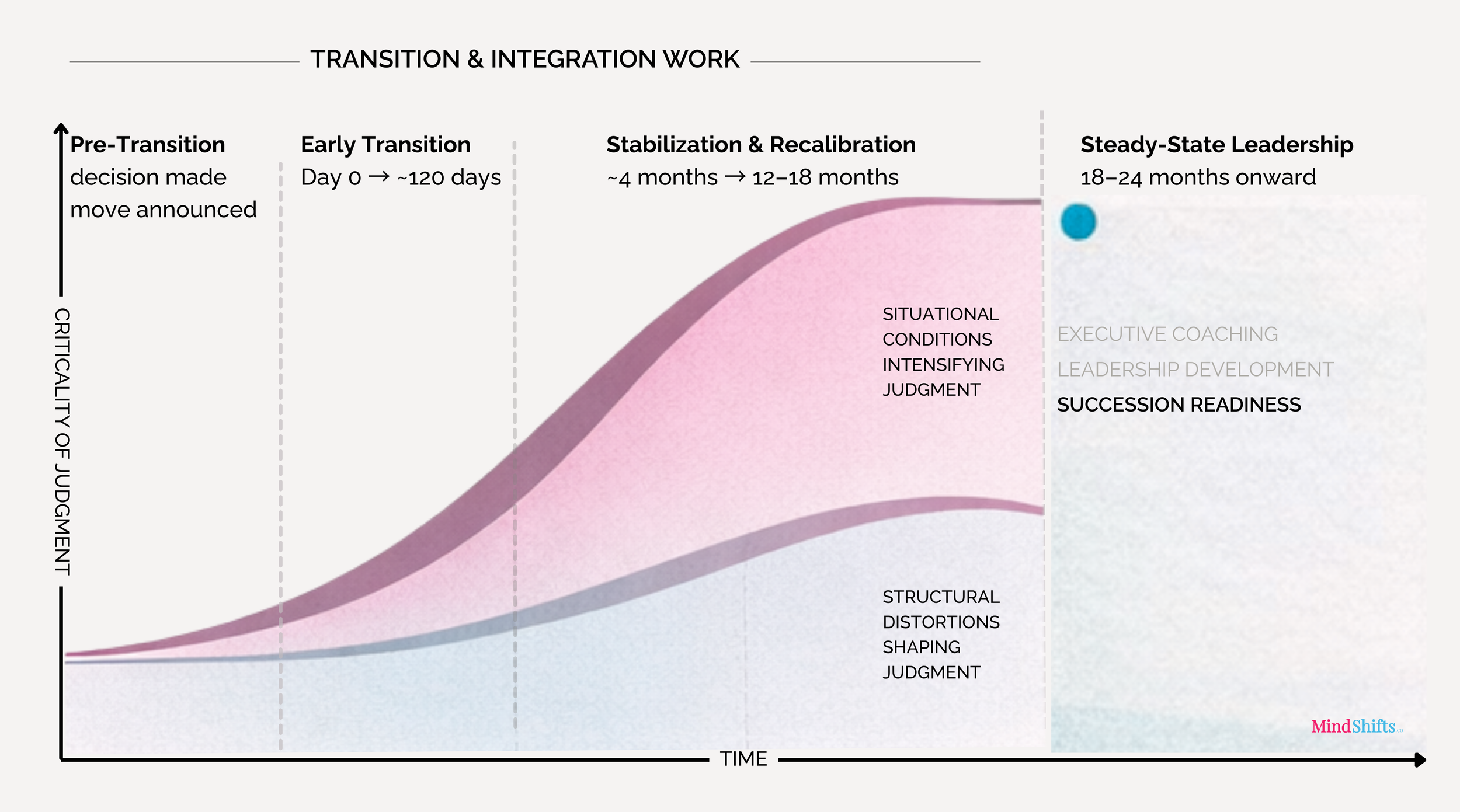
Leadership transition and integration work sits where judgment is most critical — before leadership patterns and early decisions quietly shape what follows
Leadership transitions succeed or stall. Rarely in the ways anyone anticipated.
When they stall, the system reaches for an explanation.
Culture misfit. Didn't adapt. Stakeholder friction.
These labels feel like answers.
They close the conversation.
They rarely tell you what actually happened — or when it started going wrong.
Here's what most systems miss — the moment that determined the outcome wasn't visible.
It happened early, quietly, before anyone thought to look.
The window no one is watching.
As soon as a move is decided — before Day One, sometimes before the announcement — the leader is already operating in a new context.
The system has started reading them.
Meaning is being assigned.
Early signals are being interpreted.
And the leader?
They're still carrying the internal reference points of their last role.
Feedback to them is indirect. What isn't working is hard to name. What's being misread is harder still to surface.
This is the window where patterns form. Not later. Here.
By the time something becomes visible to the organization, it has already shaped how the leader moves, decides, and holds authority.
The system sees the outcome. It wasn't watching the friction.
What the role does — before the leader does anything.
Senior leaders arrive with credibility, track record, and capability. That's why they were hired. But stepping into a new role at this level does something to anyone — regardless of experience.
Power shifts before relationships do.
Expectations rise before clarity arrives.
The authority others assign outruns the identity the leader is still settling into.
Inside, something quieter is happening.
The leader is constantly reading the room.
Calibrating what's rewarded, what's penalised.
What's actually expected versus what was said during the hiring process.
Early decisions land differently than intended.
The gap between how they see themselves and how the system sees them widens.
Judgment doesn't disappear here. It becomes more exposed.
And the organization — focused on delivery and on whether the leader is performing — rarely sees any of it.
Stabilization is not about speed.
Several months in, patterns have already formed. Some are building credibility. Others are quietly narrowing future options — without anyone naming them.
This is the highest-risk moment in any transition.
Not because the leader lacks capability.
Because early interpretations are close to hardening into a system.
Move too fast, and credibility comes at the cost of flexibility.
Move too cautiously, and authority is questioned before it fully forms.
The leader feels this acutely.
The organization usually doesn't.
What's needed here isn't a performance conversation.
It's someone who can support in stabilizing judgment while meaning and patterns are still forming —
and before early signals become fixed expectations that neither side intended to set.
Most systems don't have that resource in place.
Not at this stage.
Not for leaders at this level.
That's the gap.
What only becomes visible once judgment steadies.
When judgment stabilizes, something important surfaces.
Leaders begin to see not just what decisions they made — but how those decisions landed.
What they signalled without meaning to.
Where early credibility is now limiting the room to move.
Which expectations they set without knowing it.
These aren't questions of competence.
They're what judgment under pressure looks like — finally visible.
For CHROs, the C-Suite, and the Senior Executives:
What surfaces here tells you something no engagement survey or performance review will —
how the transition actually landed, what it cost the leader — and what it cost the people around them.
Recalibration — and it has an end.
Recalibration tends to surface in the second year. Once enough reality has settled, patterns become clear.
The question changes.
From “how I land” to “what now needs to be realigned?”
This isn't about more skills or ongoing development. It's a specific, time-bound phase. The work is to restore alignment between what the leader was brought in to do, who they are, and how their impact is actually landing.
Once that alignment is restored, this phase ends.
But only if judgment was protected earlier.
That's what most systems skip. And it's why the leader at 9-12 months sometimes doesn't match the one that was hired. No one can quite really say ‘why’.
And it gets tagged as “culture misfit.”
Where systems engage — and what it costs to wait.
Most organizations invest in senior leadership support once the role is settled.
Once the leader is performing.
Once the risk feels lower.
That's when it feels justified. Measurable. Safe.
But by that point, the judgments that shaped the trajectory have already been made.
Early moves have set expectations.
Patterns of authority and credibility have begun to harden.
What could have been addressed quietly has become a talent problem — or an exit conversation — that nobody wanted.
The question here isn't whether senior leaders need support.
It's whether that support arrives when judgment is most exposed,
or only after the system has already decided something went wrong.
Where a system chooses to engage is not neutral.
It determines whether integration succeeds — or whether culture misfit becomes the explanation for something that was never really that at all.
One more thing worth considering.
This isn't only a system failure.
Leaders stepping into senior transitions also carry responsibility.
The system cannot be expected to reconfigure overnight.
Culture, relationships, ways of working — these take time to shift, and
a leader who arrives expecting immediate accommodation will find friction everywhere.
The leaders who integrate well don't wait for the system to meet them. They read it carefully. They pick their moments. They protect what matters most about how they work — and stay curious about everything else.
The hard truth is that calibration runs both ways.
The system needs to create the conditions.
The leader needs to navigate them.
When either side opts out of that responsibility, integration stalls — and the label that follows rarely tells the real story.